

Melamine board
Compression nests for kitchen and shopfitting.
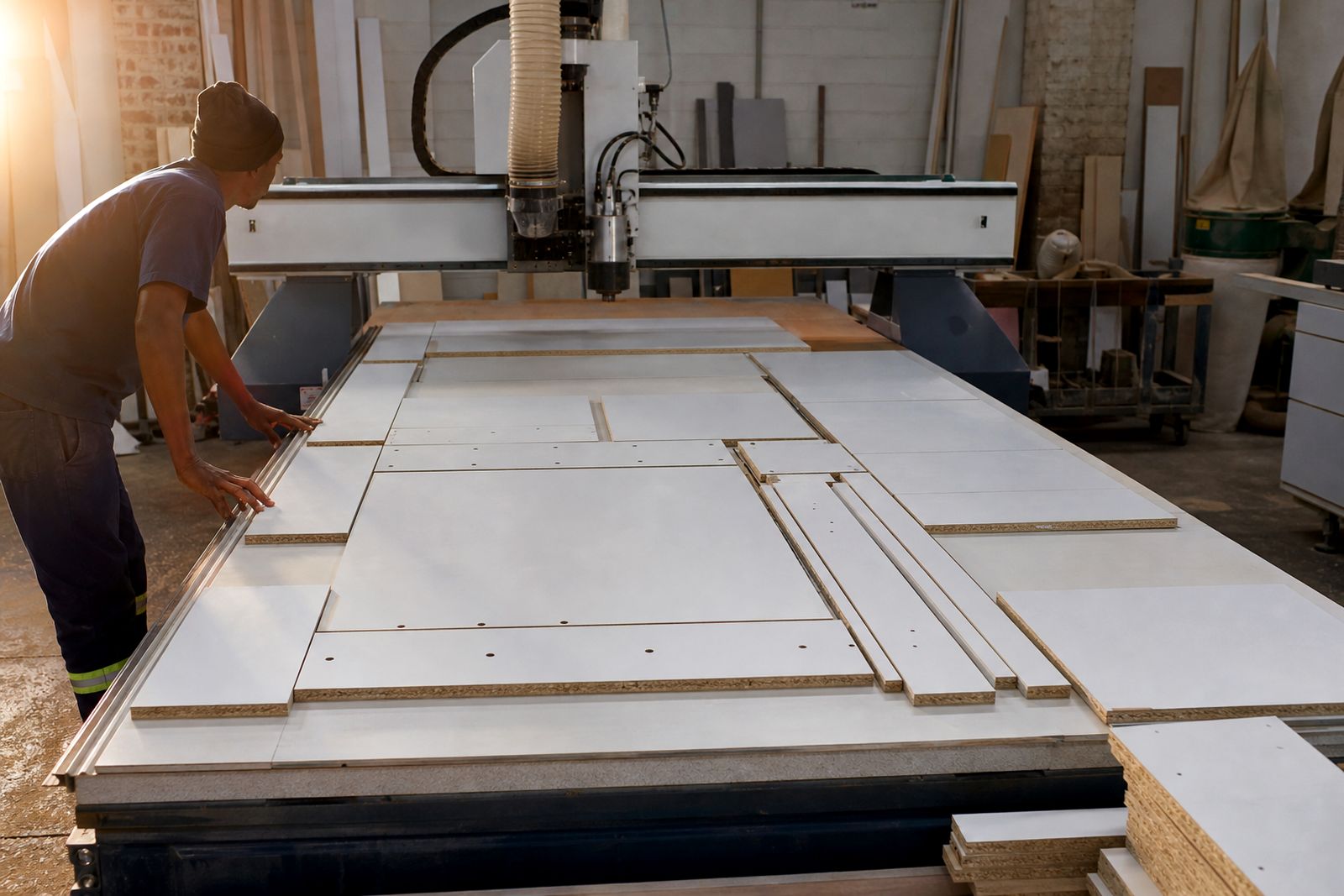
Melamine board for cabinetry and panel cutting
Melamine board is the workhorse panel for modular kitchens, cabinets and shopfitting. Compression spirals give the cleanest top and bottom edges on nested parts, ready for edge-banding.
Pair with the tool range and the feeds card.
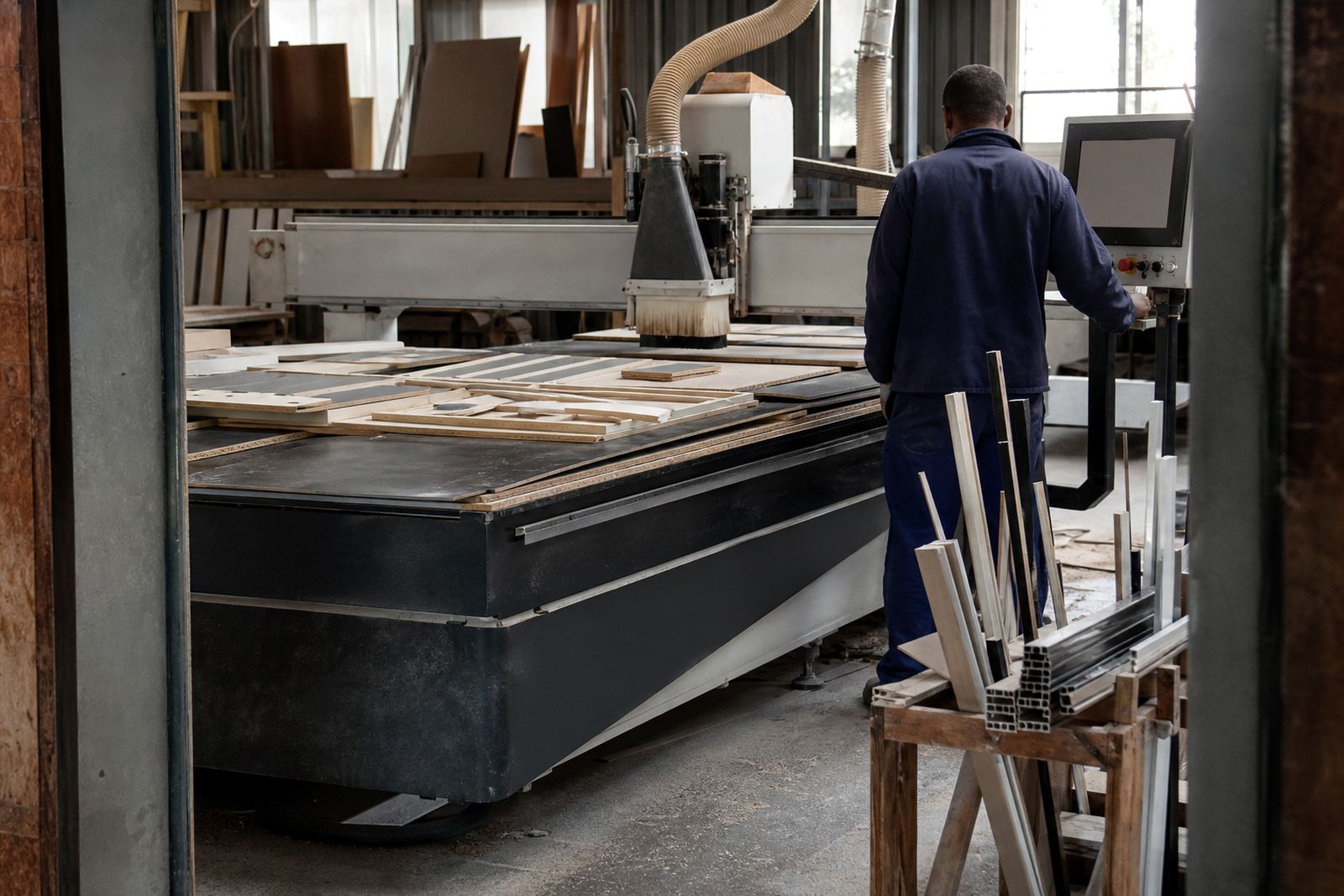
Most kitchen and built-in cupboard shops in South Africa cut white or coloured melamine-faced chipboard or MDF, 16 to 18 mm thick, on their CNC routers. The decorative face is a resin-impregnated paper pressed onto both sides, giving a hard, scratch-resistant surface but a brittle edge if chipped while cutting. Tightly nested panel layouts are common for optimising yield in cabinet runs, shopfitting, office furniture and point-of-sale counters.
Chip clearance is crucial since the dust is fine and the core is not as tough as solid wood. The laminated surfaces splinter easily with the wrong cutter or poor support. Tooling and cut strategies are all about crisp, chip-free edges and dimensional accuracy, especially when parts will be edge-banded or pocketed for hinges and hardware.
Compression spirals for melamine board
For melamine board, our team recommends using a 2-flute or 3-flute solid carbide compression spiral for nesting and trimming passes. These tools have up-cut geometry at the tip and down-cut above, pulling the chip in both directions to leave a clean edge on both faces. They are the first choice for cut-outs and component shapes, minimising edge chipping and reducing the need for hand finishing.
Single-flute up-cut spirals or straight cutters work for roughing or pocketing, but will usually leave some top-edge breakout. Down-cut spirals give a perfect top edge but can lift the panel if vacuum or clamping is weak. For hinge recesses and slots, a straight or up-cut spiral gives good chip evacuation.
For compression spirals, a typical starting point on a 3 to 12 mm cutter is 4 to 6 m/min feed, 18,000 to 20,000 rpm spindle speed, 3 to 4 mm stepdown per pass, and 40 to 60% stepover. Always test on offcuts and adjust for your exact material and hold-down. Check collet and nut condition, and use a torque wrench for consistent clamping.
- 2-flute or 3-flute compression spirals for main cuts
- Single-flute up-cut for hinge recesses and deep pockets
- Straight cutter for slots and rebates
- Down-cut spiral for trimming with strong hold-down
- Printable feeds and speeds cards for your workshop
Protect melamine panels from moisture
Melamine board is stable in normal conditions but still sensitive to moisture, especially at the coast or in damp winter weather in Durban and Cape Town. Panels can swell at the edges or warp if exposed to humidity swings, so keep them wrapped or under a waterproof sheet and off the concrete floor. Inland workshops on the Highveld have fewer moisture problems but should still keep panels in a dry, shaded area.
Store boards flat on a level support. Even a slight bow will affect vacuum hold-down and may compromise part accuracy or cause chatter. Leave any factory protective film in place until just before machining to reduce surface scratches and scuffing. Use a clean spoilboard and check it is flat before vacuum nesting.
CuTool keeps melamine offcut samples at Sunnyrock for test cuts and tool trials, and can organise courier delivery of small panels if you want to dial in a new programme or cutter before a big run.
What our Cutting Tool customers say
Verified Google reviews
Also worth a look
Tell us about the job you need to cut
Send a note through our contact form with your machine, spindle and collet size, the material and thickness, the finish you need and your area, and we will come back with practical cutter options and a quote.
Open the contact form