

Foam relief
Relief foam prep for taper ball-nose work.
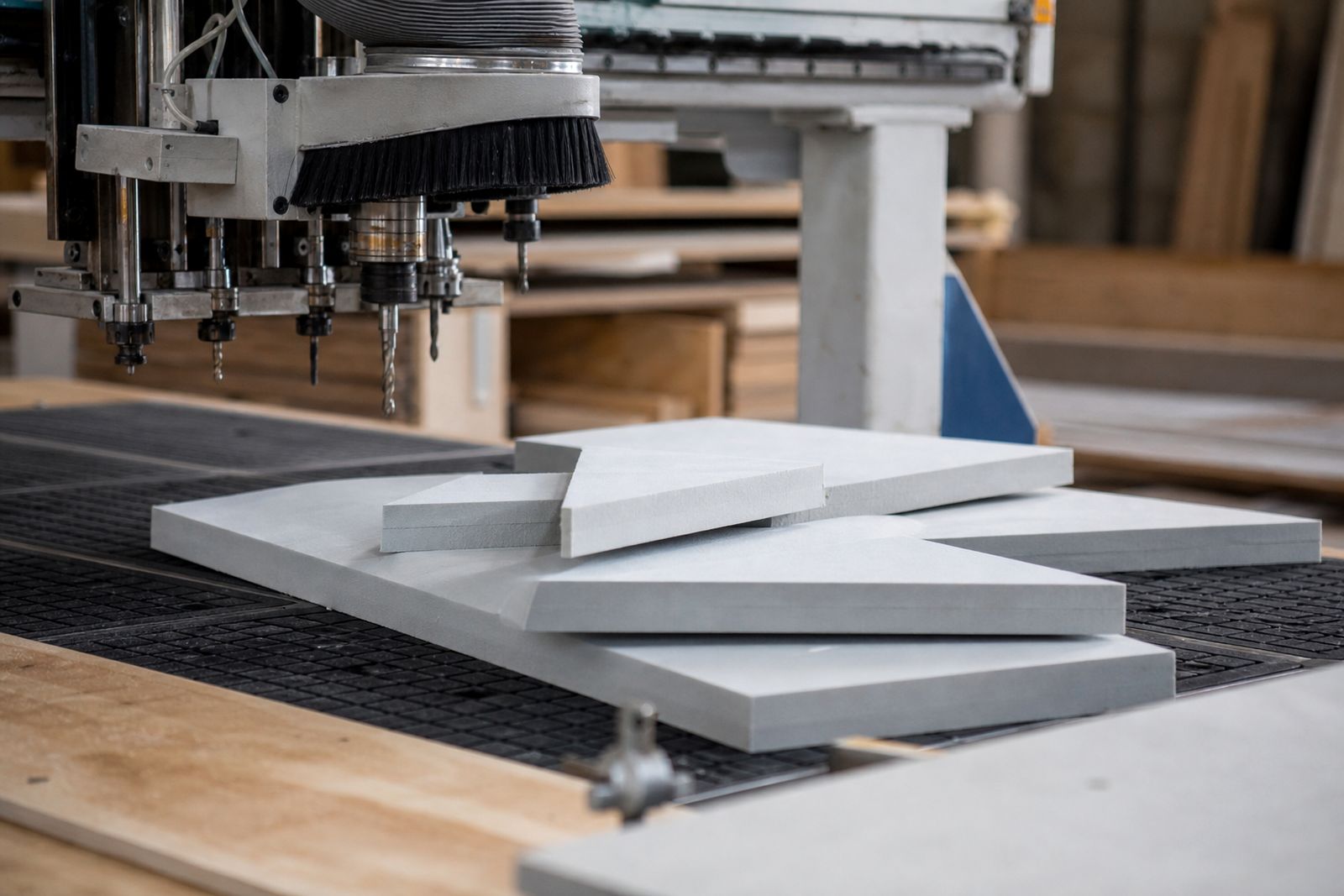
Foam relief for 3D carving and display
Relief foam is a lightweight, closed-cell urethane or polystyrene-based sheet, easy to shape for three-dimensional signage and display work. It cuts cleanly with sharp tools and is forgiving for deep or complex relief passes.
Pair with the tool range and the feeds card.
Relief foam, sometimes called signfoam or high-density modelling foam, is a rigid, closed-cell material engineered for CNC machining. South African shops use it for routed 3D signs, exhibition props, theatre backdrops and as a pattern or mould base in foundry or composite work. It’s lightweight, dusts off easily and holds fine detail, making it popular for quick-turn signage, background letters, and themed architectural elements.
The material is forgiving of deep passes and overcuts, so relief work with broad sweeps or fine surface textures is possible in one setup. It resists chip-out, but benefits from sharp, well-evacuated cutters to prevent melting or smearing, especially during summer Joburg heat or in humid Durban conditions.
Taper ball nose cutters for smooth foam relief
For relief carving, our team recommends solid carbide taper ball nose end mills, generally 3 to 12 mm diameter at the tip with up to 8-degree taper. Two-flute cutters are most common for this work, clearing chips effectively while leaving a smooth finish. Single-flute options are also available for rapid clearance on deep roughing passes.
Typical starting feeds are 3500 to 6 000 mm/min at 18,000 rpm, with a 1.5 to 4 mm stepdown per pass depending on the foam’s density. Stepover can range from 10 to 50 percent of the tool diameter for balance between detail and finishing time. Always adjust based on a test cut, chip load per tooth should be generous to prevent rubbing, but not so high as to risk surface tearing.
Keep the cut dry, as mist cooling is unnecessary and can affect paint or adhesion later. Use a light air blast or dust extraction to avoid buildup. Check that your collet is clean and runout is under 0.02 mm measured with a dial indicator for best surface quality.
- Solid carbide taper ball nose, 3 to 12 mm tip diameter
- Two-flute and single-flute options
- 3500 to 6 000 mm/min feed, 18,000 rpm spindle as a starting point
- Stepdown 1.5 to 4 mm, stepover 10 to 50 percent
- No coatings needed for relief foam, uncoated tools preferred
Prevent warping and moisture pickup in foam
Relief foam stores best when kept flat and supported, as it can develop bowing or cupping if left standing upright for long periods, especially in Highveld winter or during coastal humidity in Durban and Gqeberha. Avoid stacking heavy items on top of sheets. Most relief foam boards are shipped with a thin peel-off plastic film; keep this on until the last moment before machining to protect against dust and minor knocks.
Inland, static and dryness can attract fines and make sheets brittle, so a damp (not wet) cloth wipe reduces static before handling. At the coast, high humidity can lead to surface moisture, which may interfere with paint or glue after machining, so allow air-drying if condensation forms.
On the CNC, use a vacuum table for best hold-down. For lighter hobby machines or where a vacuum is not available, double-sided tape or low-tack spray adhesive can secure the foam without crushing. Always check for full contact between the foam and the spoilboard, and avoid clamping too tightly, which can deform the sheet and affect carving depth accuracy.
What our Cutting Tool customers say
Verified Google reviews
Also worth a look
Tell us about the job you need to cut
Send a note through our contact form with your machine, spindle and collet size, the material and thickness, the finish you need and your area, and we will come back with practical cutter options and a quote.
Open the contact form