

Hobby starter pack
Starter pack and runout check for a hobby spindle.
Getting a small garage CNC ready for real work
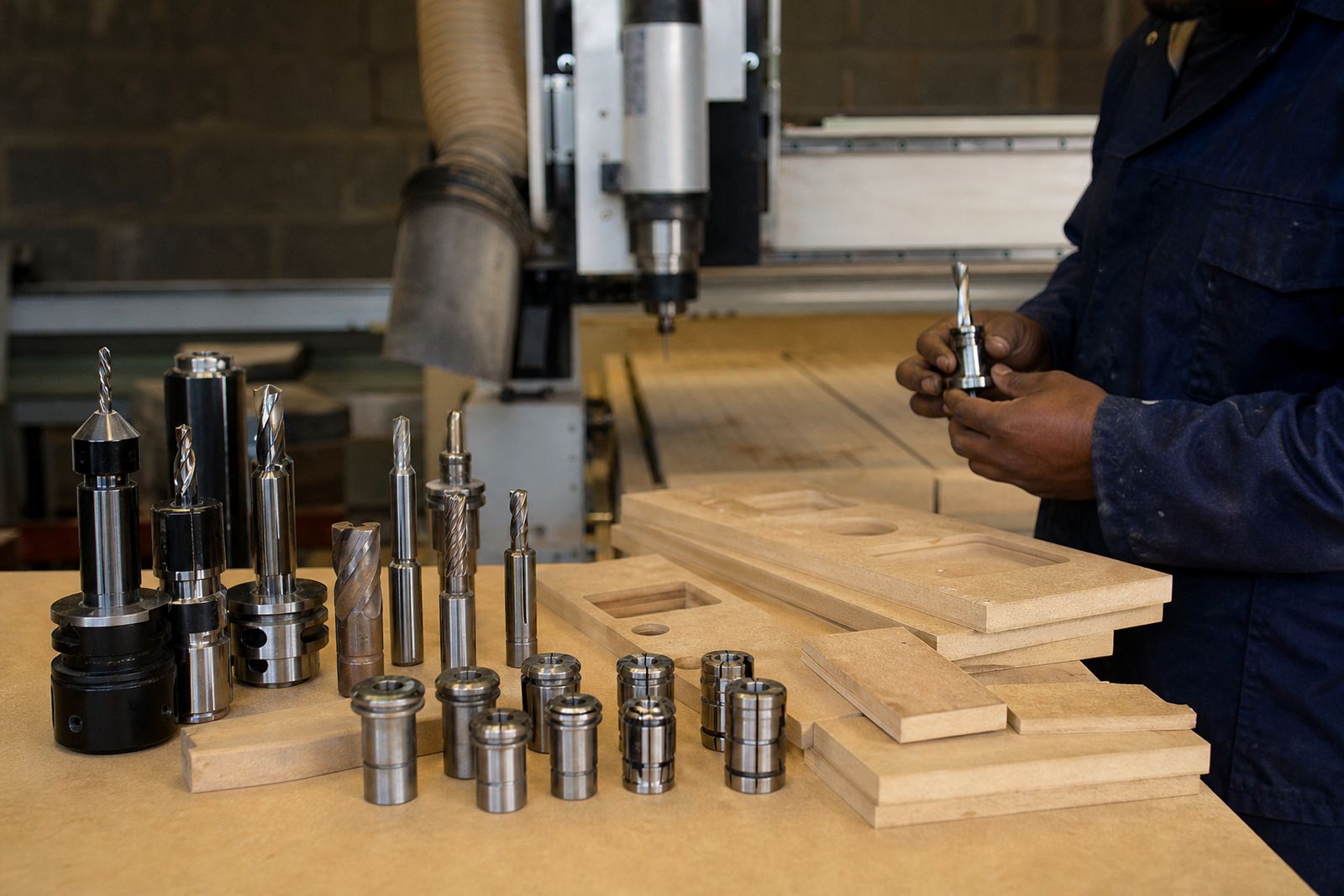
A Soweto home workshop needed to get the right starter tooling and check their spindle runout for a new CNC. The CuTool team suggested starter tooling and a runout check for clean, accurate cuts from the start.
Related: workshop guides and the tool range.
This Soweto garage was set up for a hobby CNC router, with dreams of making custom signs and furniture pieces. The owner had a basic 2.2 kW water-cooled spindle and a lightweight gantry, but wasn’t getting the smooth finish or dimensional accuracy he expected on MDF and birch ply.
On the information you send us, we can review spindle runout issues and advise on likely causes of fuzzy or inconsistent cuts, especially on small lettering. Collets had never been cleaned, the nut was hand-tightened, and the original cutters were low-budget imports, mostly double-flute straight bits with some chipped edges.
Supplying a starter pack and checking the spindle runout
We put together a starter pack for him with three solid carbide end mills: a 3 mm two flute upcut for profile work, a 6 mm compression spiral for cleaner laminate edges, and a 6 mm single flute for acrylic. To fit his ER20 collet holder, we included a new ER20 collet and a torque spanner to get the nut to the right tension. For runout, your team or a qualified contractor should sweep the collet nose with a dial indicator, and we can review the photos, check stick out and confirm whether the tool is seated correctly from the information you send us.
After swapping out the old collet and re-tightening with a torque spanner, spindle runout dropped to just under 0.02 mm at 15 mm stick-out. Chip loads were set at 0.04 to 0.12 mm per tooth, and we walked through ramping into the cut, climb vs conventional finishing, and the difference between upcut and compression edges when working with MDF and melamine.
- 3 mm two flute upcut for fine profiles
- 6 mm compression spiral for board edges
- 6 mm single flute for acrylic
- New ER20 collet and nut
- Torque spanner for proper tightening
What changed in the garage and what we would do next time
Afterwards, the workshop ran cleaner, with better edge finish and less sanding needed. The owner kept a printout of feeds, speeds and tool-life tips above the controller and put a monthly collet check on his workshop calendar.
His MDF signs and one-off cuttings improved, and he started experimenting with onion-skin passes for better hold-down on small parts. If we did this again, we would add a small mist coolant kit for plastics, and encourage him to try a chip-breaker spiral for tougher hardwoods. Most importantly, he now checks his tooling and spindle every month, not just when a cut goes wrong.
What our Cutting Tool customers say
Verified Google reviews
Also worth a look
Tell us about the job you need to cut
Send a note through our contact form with your machine, spindle and collet size, the material and thickness, the finish you need and your area, and we will come back with practical cutter options and a quote.
Open the contact form