

Router bit starter specs
Twelve essential bits for versatile joinery, MDF, and signage work.

How to read the specs for your job
| Pieces | 12 |
|---|---|
| Shanks | 6 and 8 mm |
| Spirals | Up / down / compression |
| Card | Feeds for pine and MDF |
| Ideal for | Joinery, school cells |
Router bit starter suits joinery, school cells. Tell us your spindle, collet size and material and we will confirm the size.
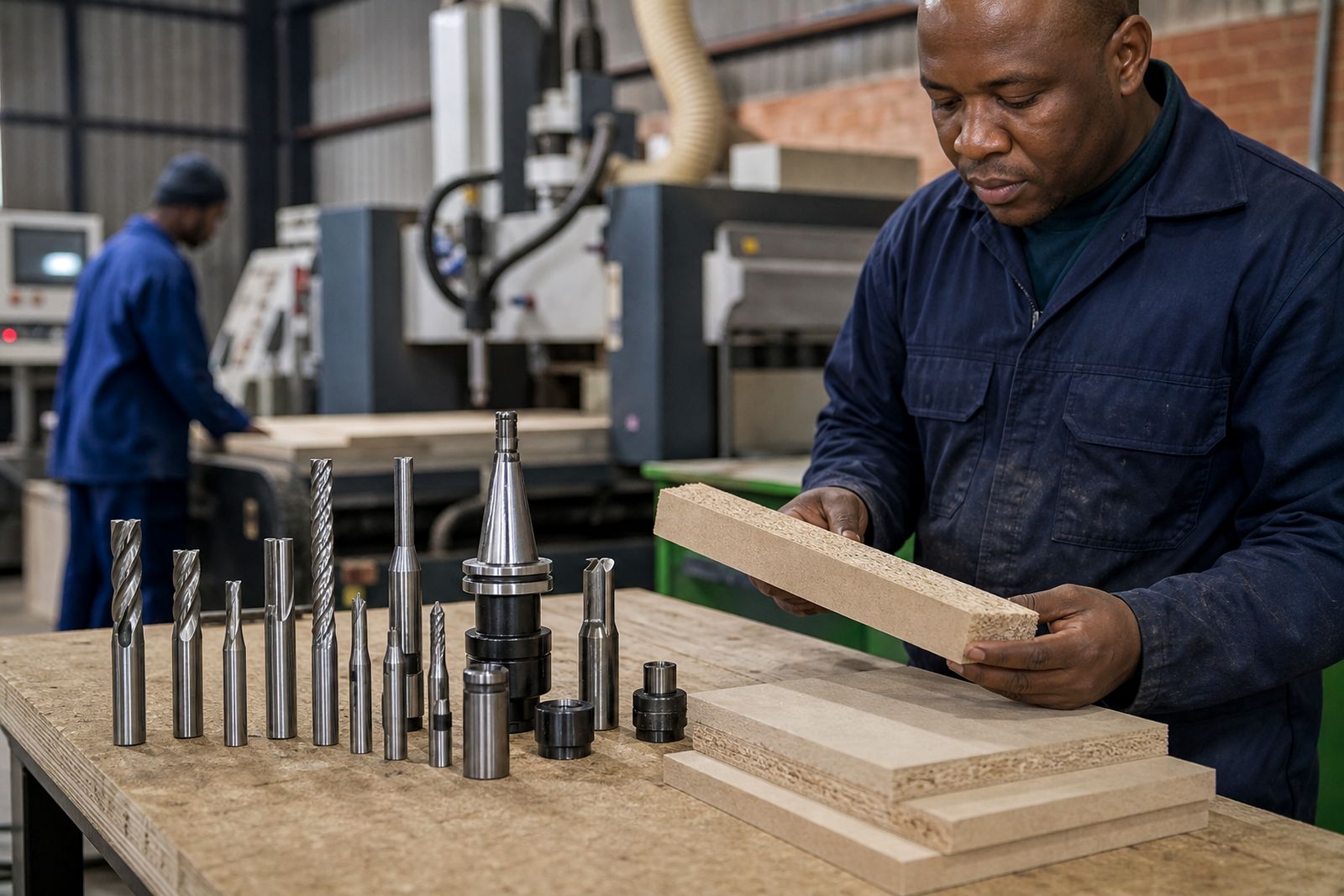
Each router bit starter kit contains 12 pieces covering the core geometries: upcut, downcut, compression and straight. The shank sizes, 6 mm and 8 mm, are chosen to suit both light-duty compact routers and heavier spindle machines common in school workshops and small joinery shops. Upcut spirals give fast chip clearance for deep grooves in pine or chipboard. Downcut spirals cut clean top edges, ideal for visible joinery or sign letters. Compression spirals, which have up and down flutes meeting near the tip, stop edge tearout on both faces of veneered MDF. The straight cutters are single-flute for sharp inner corners in letters or pockets.
Feeds, speeds and starting points
Every tray comes with a printed card to keep at the machine. For 6 mm spirals in pine or MDF, start with 12000 rpm, 1.2 to 1.8 metres per minute feed, and 2 to 2.5 mm depth per pass. For 8 mm cutters, 12000 to 16000 rpm is typical, with 2.0 to 3.0 m/min feed and 3 mm stepdown. Downcut and compression bits may need a slower feed to avoid pulling chips into the cut. Always test on offcuts first, check for burning, and adjust feeds for your spindle power and dust extraction. Chip load per tooth should be 0.06 to 0.10 mm as a starting point.
- Pine: 12000 rpm, 1.5 m/min, 2 mm stepdown (6 mm bit)
- MDF: 12000 rpm, 2.0 m/min, 2 mm stepdown (6 mm bit)
- Pine: 14000 rpm, 2.5 m/min, 3 mm stepdown (8 mm bit)
Checking your spindle and collet before ordering
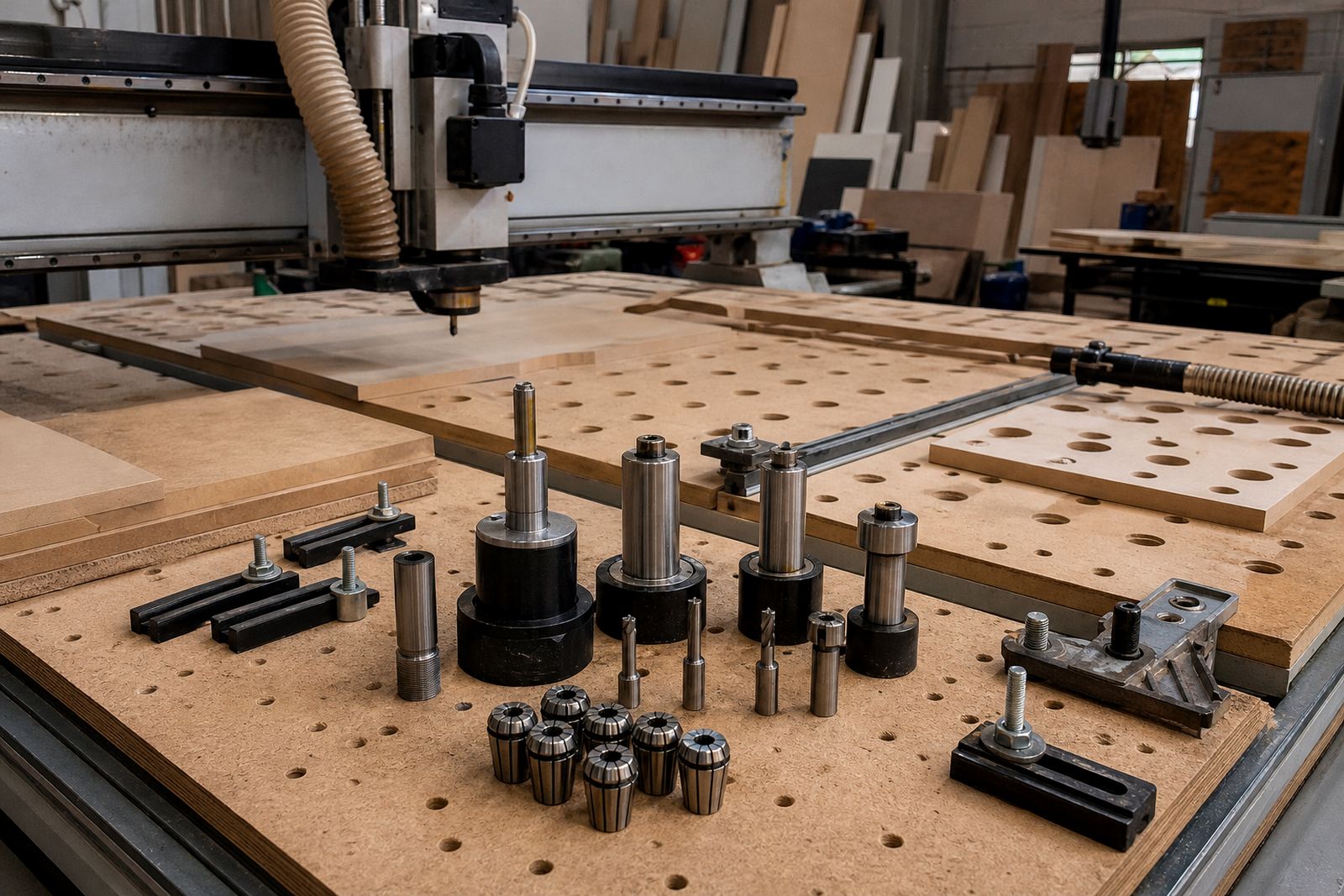
Measure your spindle’s collet type and range: most school and hobby routers take ER11 for 6 mm, while small joinery spindles may use ER20 for 8 mm. Stick-out should be just enough for safe clamping, never more than 1.5 times the shank diameter, to keep runout low. If you have a dial indicator, check runout at the tool tip: under 0.02 mm is ideal. Clean your collet and nut thoroughly before fitting a new bit. Do not use force if the fit is tight; never run a damaged or bent shank.
- Check ER size (ER11 or ER20)
- Keep stick-out under 1.5× shank diameter
- Clean collet and nut before clamping
What our Cutting Tool customers say
Verified Google reviews
Also worth a look
Tell us about the job you need to cut
Send a note through our contact form with your machine, spindle and collet size, the material and thickness, the finish you need and your area, and we will come back with practical cutter options and a quote.
Open the contact form